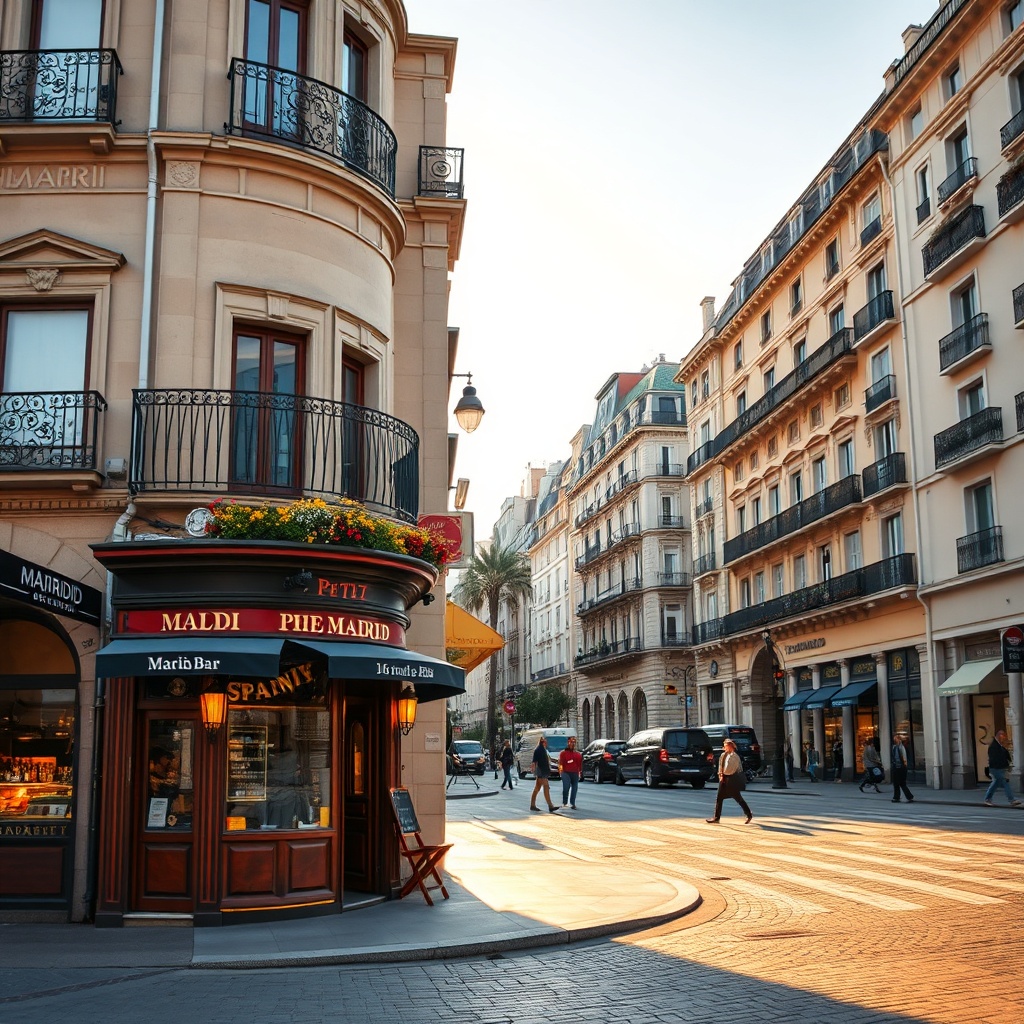
Walk five minutes in any direction from a school in Madrid and you'll pass more than a dozen bars and liquor stores. Within 500 meters, the average school had 79 alcohol outlets. Does that density make teenagers drink more? A cross-sectional study published in Health & Place tracked 49 schools across the city and found: no, it doesn't.
What they did
Researchers mapped 49 schools across Madrid neighborhoods spanning a wide range of socioeconomic position (SEP) — a composite measure of wealth, education, and occupational status in a given area. For each school, they counted every licensed alcohol outlet within a 500-meter street-network buffer — the actual walking distance, not a straight line on a map. They then distributed questionnaires to students aged 14 to 18, asking about lifetime drinking, past-30-day drinking, past-7-day drinking, and binge drinking in the previous month. Data collection ran through 2021 and 2022. To determine which variables to adjust for, they built a directed acyclic graph — a structured diagram of causal assumptions — and ran robust Poisson regression models comparing outlet density to each consumption measure.
What they found
- Two in three students (67%) reported having drunk alcohol at least once.
- Drinking was more common among older students, girls, those with more pocket money, those who perceived drinking as low-risk, and those whose parents drank more.
- Students attending schools in wealthier neighborhoods reported more drinking than those in lower-SEP areas — not less.
- After full adjustment, the number of alcohol outlets near a school had no statistically significant association with any drinking measure: lifetime, recent, or binge.
What it means
The researchers offer one explanation: when an environment is already saturated with alcohol retail, additional outlets may stop mattering. There's a threshold past which denser supply no longer drives up use — not because consumption is stable, but because the signal has long been drowned out. At 79 outlets per school, Madrid may be well past that point.
So if density isn't what's moving the needle, what is? The data point toward parental drinking habits, disposable income, and risk perception. In a place where physical access to alcohol is already everywhere, those are the variables that actually differentiate who drinks and who doesn't.
67% of 14-to-18-year-olds had tried alcohol at least once. That's not the outlet count doing that — normalization runs through family and peer channels. Spending power mattered. Parental drinking mattered. The number of bars within walking distance didn't.
When access is already maxed out, it stops being the limiting variable. The things that move behavior are harder to map and harder to regulate: what your parents drink, what your friends expect, how much cash you're carrying.
Caveats
Cross-sectional studies can identify associations but not causes. Students reported their own drinking, which tends to understate actual consumption. The study didn't capture alcohol delivery or home availability, and its findings describe one city with unusually high baseline saturation — they may not generalize to less dense environments elsewhere.
Source: Health & Place, doi:10.1016/j.healthplace.2026.103669