
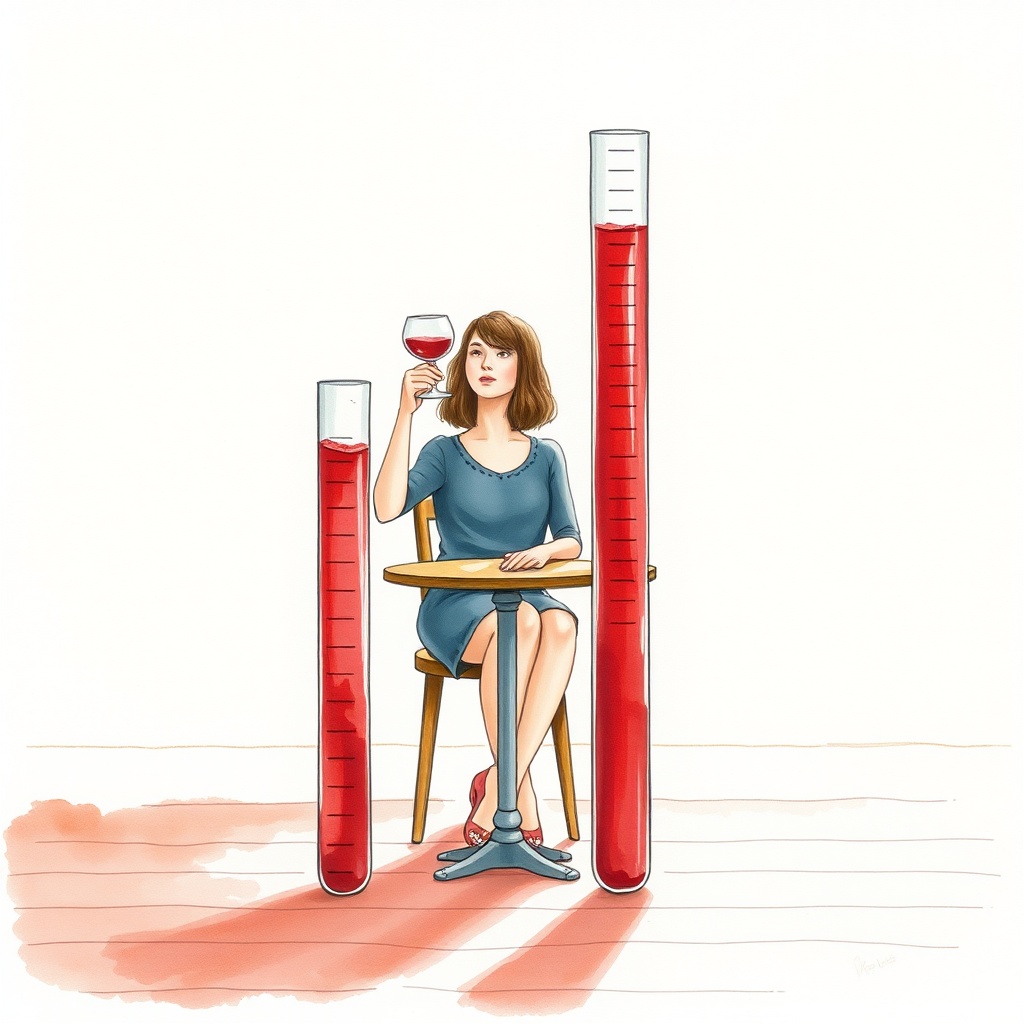
Nearly everything we know about moderate drinking and health comes from people telling researchers how much they drink. Think about how you'd answer that question. A glass with dinner on Tuesday, maybe two on Friday, and the wedding you'd rather not count.
That's a known weak spot. I've written before about how wine health studies keep tripping over the same methods problems, and self-report sits right in the middle of it. The authors of this paper say it plainly: there are no validated biomarkers for low to moderate drinking. Heavy drinking leaves traces in the blood. One or two drinks a day mostly gets estimated from what people say.
So can blood tell you how much someone drank, even at a glass or two?
What they did
The study is called the Postmenopausal Women's Alcohol Study. Researchers enrolled 51 postmenopausal women and controlled their diet completely.
Each woman went through three phases, eight weeks each, in random order:
- 0 g of alcohol a day
- 15 g a day (about one drink)
- 30 g a day (about two drinks)
Between phases came a washout break with no alcohol. It's a crossover design, so every woman was her own comparison. With only 51 people that matters a lot: differences between individuals mostly cancel out.
The team drew fasting blood at baseline, after each washout, and at the end of each phase. They measured 1,422 metabolites, the small molecules your body makes, breaks down, or takes in. Then statistical models showed which of them moved with the dose.
What they found
Of the 1,422 metabolites, 150 had already been linked to alcohol in earlier observational studies. In this trial, alcohol significantly changed 46 of them.
- Ethyl compounds. Ethyl glucuronide and ethyl α-glucopyranoside, two molecules tied directly to alcohol, rose with intake.
- Amino acid byproducts: α-hydroxyisovalerate and 2-aminobutyrate.
- Hormones. Several androgenic steroids changed.
- Fats. Multiple phosphatidylcholines moved as well. That's a family of fats found in cell membranes, and it's the group I'd least expect to react to one drink.
Ethyl α-glucopyranoside was the big one. Compared with no alcohol, it rose 461% at one drink a day and 900% at two. More alcohol, more marker, in steps you can actually see.
The researchers confirmed 14 alcohol-linked metabolites from previous studies and found a number of new candidates.
What it means
The real payoff is for researchers. Large health cohorts already store metabolomics data for thousands of people. If these markers hold up, scientists can check alcohol exposure directly in those samples instead of trusting a questionnaire filled out years ago. That could sharpen the whole fight over whether light drinking helps or harms, which so far hasn't survived careful analysis well.
What surprised me is how sensitive the signal is. One drink a day, with food, under controlled conditions, and a single molecule climbs more than fivefold. Your body keeps a more honest record than your memory does.
I wouldn't stretch this too far, though. All 51 participants were postmenopausal women on a controlled diet. How well the markers carry over to men, younger women, or messy real-life drinking, I don't know. And a shift in steroids or membrane fats doesn't tell you whether anything good or bad is happening. It only shows that something measurable moves at doses many people call trivial.
That gap between what people recall and what actually happened is also why I build AlcoBalance the way I do. You can't remember a number you never noticed. If you log a drink when you have it, you see where your evening is heading while it's still going: how high your peak will get and when it fades. Then you decide in the moment, not the next day while rebuilding the night from memory.
A blood test can say what you drank last week. I'm more interested in what you notice tonight.
Source: The Journal of Nutrition, DOI