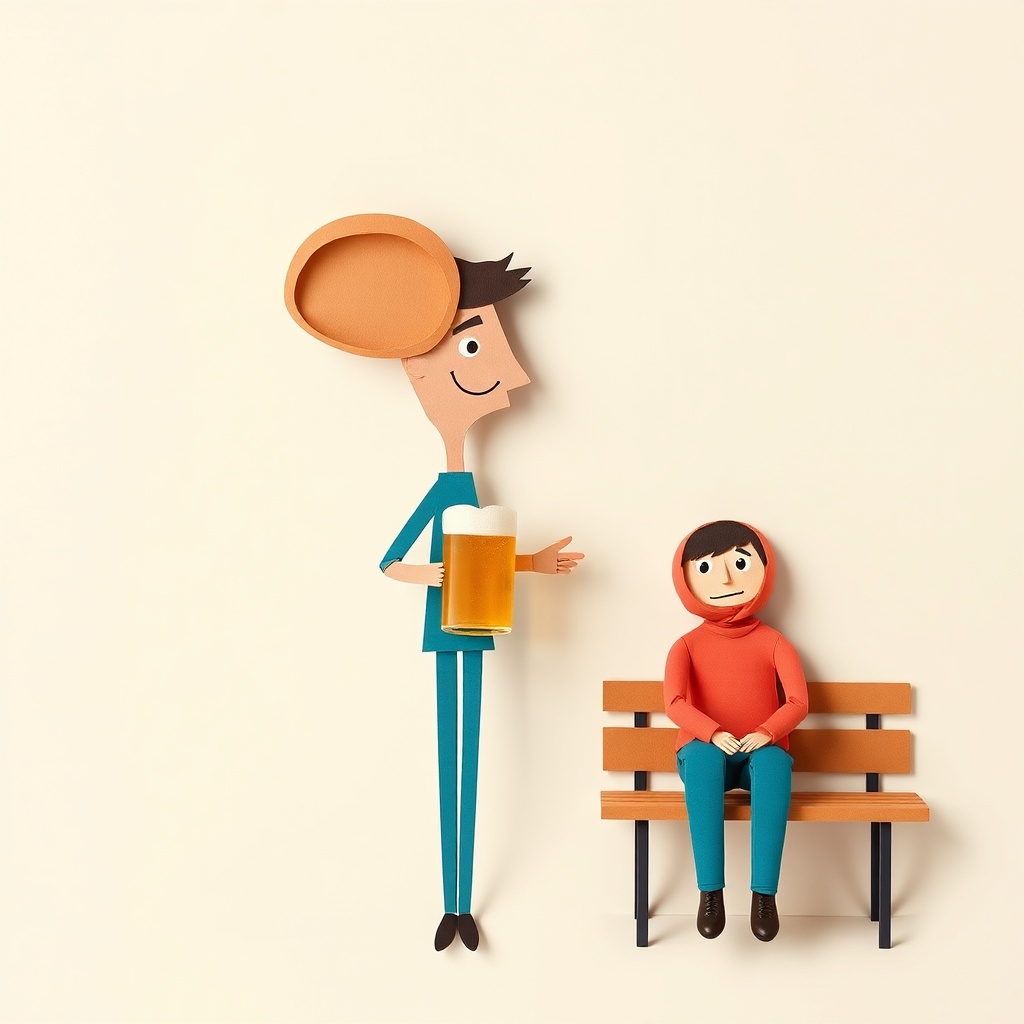
Sixty-six people watched strangers tell emotional stories from their own lives. Some drank beer, the rest drank a 0.0% copy of the same beer. After alcohol, they could still tell how the speakers felt. The change was quieter: some of the drinkers became less willing to help a person in pain.
I expected a simple replication. What I found was a bit stranger.
What they did
An earlier study found that men who drank a moderate dose of hard liquor got worse at reading positive emotions in others. The drop was clearest among people whose drinking wasn't risky to begin with. This team wanted to know whether the same thing happens with beer.
The setup:
- 66 participants, 62% men
- 28 drank beer at 6.6% alcohol, 38 drank the 0.0% version of it (the placebo)
- Everyone filled in questionnaires first: the AUDIT (a standard screen for risky drinking), a trait empathy scale, and a survey on why they drink
Then came the main task. Participants did it once before drinking and once after. They watched video clips of people talking about emotional events from their own lives and rated how each speaker felt while talking. Researchers call this empathic accuracy. In plain terms, it's how well you can tell what someone else is feeling.
The team also added a new measure. Participants read scenarios about people in pain and said whether they would help. That's the behavioral side of empathy: not what you notice, but what you'd do about it. One caveat: the scenarios were hypothetical. They measure what people say they'd do, not what they actually did.
What they found
- Reading emotions. The earlier finding did not replicate. Beer didn't make people worse at reading positive emotions in the clips.
- Helping. After alcohol, people whose drinking wasn't risky were less willing to help people in pain.
- Moderators. Neither trait empathy (how readily someone tends to feel what others feel) nor drinking to cope changed the results in any meaningful way.
The authors' own conclusion is careful. Alcohol may change empathy, but the effects aren't consistent and may depend on the dose and the type of drink. They also say trait empathy and aggressiveness need a closer look.
What it means
Two things stood out to me.
First, the split between seeing and doing. In this study, a moderate dose of beer left perception intact. People still read the sad story as sad. The shift came one step later, in whether they'd act on it. That's an uncomfortable kind of change, because nothing tells you it happened. You still get the story. You just care a little less about doing anything about it.
Second, the effect landed on lighter drinkers. The earlier liquor study pointed the same way, so it's probably not a one-off. My guess (and it is a guess, the abstract doesn't test it) is that people who drink more often are already used to how a moderate dose feels, while lighter drinkers get the full effect of the same amount. If that's right, "it's just a couple of beers" means very different things for different people.
I'd hold all of this loosely. The groups were small: only 28 people actually drank. And the main result from the previous study simply didn't show up here. One finding failed to replicate and a new one appeared, which is why the authors call the effects inconsistent.
Still, the pattern fits something I keep running into: alcohol changes us in ways we don't feel from the inside. In a related study, the most intoxicated people were the worst at judging how drunk they were. This time it's generosity rather than intoxication, but the blind spot looks the same.
That gap between how you feel and where you actually are is what I'm building AlcoBalance around. A couple of beers in, nobody feels less kind. But if you can see your own rhythm and how far you are from your peak, you get a moment to notice that the evening has already moved you a bit. Then you can decide how the rest of it goes while you're still the one steering.
I don't read this as a reason to drink less. I read it as a reason to know which version of yourself is in the room when a friend needs a hand.
Source: Human Psychopharmacology, DOI