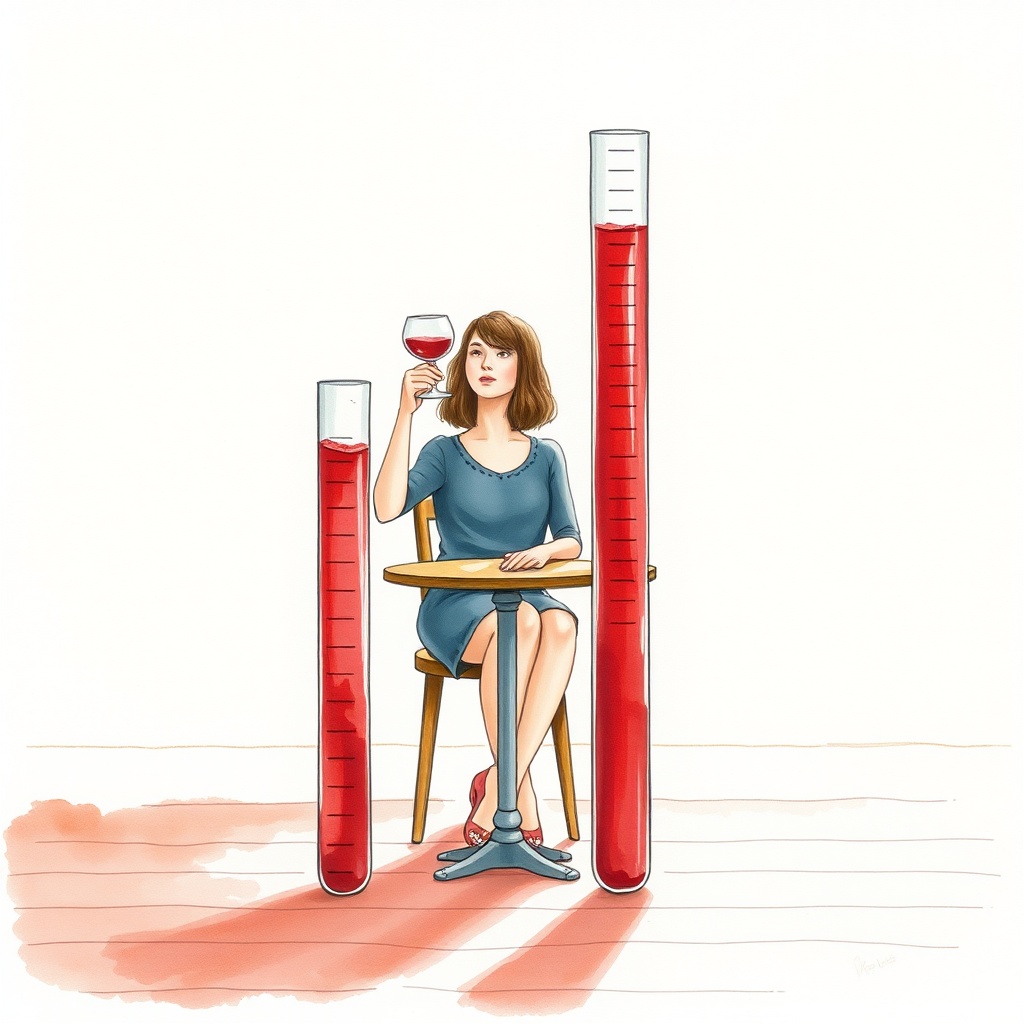
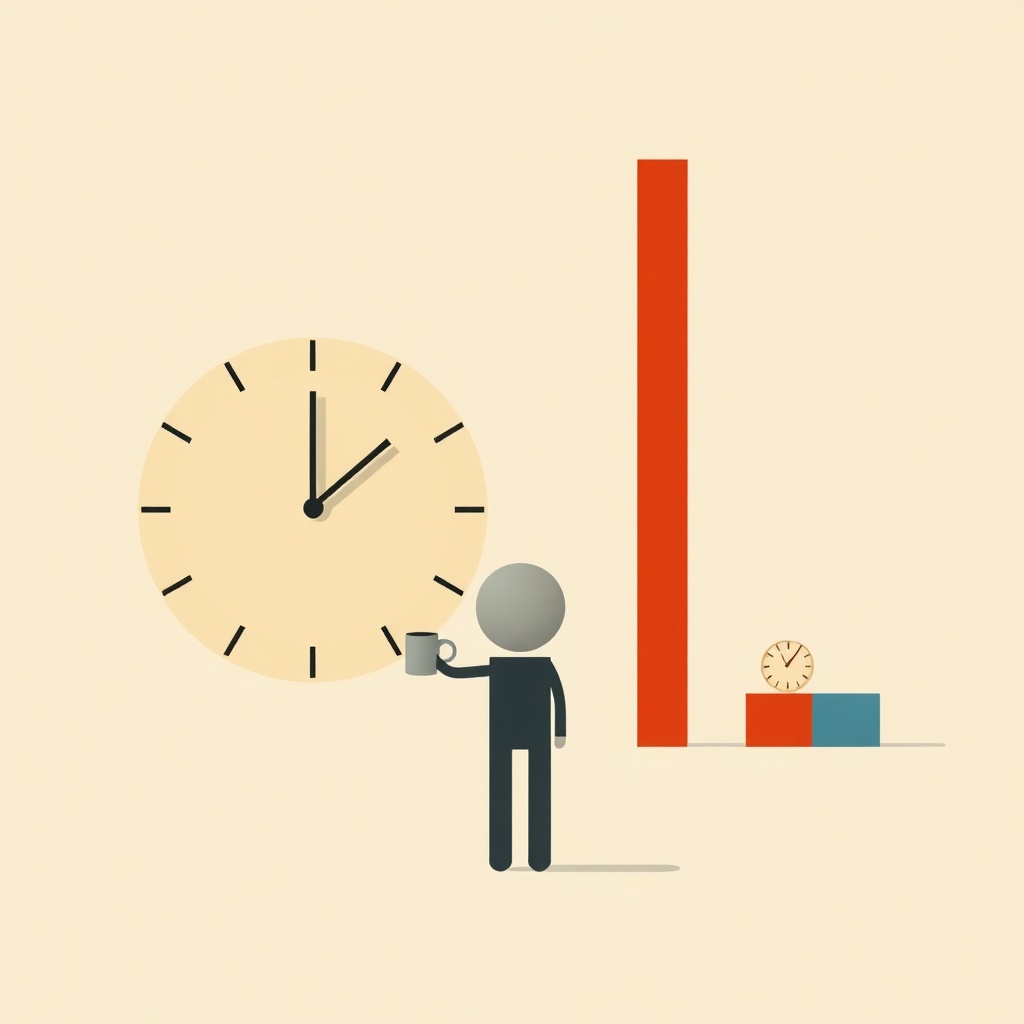
Two people hand in a urine sample on the same Thursday morning. One had six drinks on Tuesday night. The other had two beers late on Wednesday. Which one gets the higher alcohol reading?
My gut said the six-drink person. A new study says the clock matters much more than the count.
The test measures ethyl glucuronide in urine (uEtG). It's a compound that shows up after drinking, and clinical trials use it as an objective check on whether someone drank, because it doesn't rely on anyone's memory. What nobody had pinned down well is what a given uEtG number actually says about the last drinking episode. Was it recent? Was it big? Both?
What they did
Researchers worked with 349 adults recruited for an AUD (alcohol use disorder) clinical trial. Before treatment started, there was a four-week observation period. Participants gave urine samples at baseline and then twice a week.
With every sample, people also reported:
- how many hours had passed since their last drink
- how many standard drinks they had at that last occasion
The team also tried two ratios built from those numbers: hours per drink and drinks per hour.
The lab measured uEtG with a commercial immunoassay (the ThermoFisher DRI test) on a scale from 0 to 2,000 ng/mL. Then they picked cutoffs at 100, 500 and 2,000 ng/mL, which roughly map onto light through heavy drinking. For each cutoff, they compared what people reported when their sample landed below the line versus above it. The statistics were generalized linear mixed models, a method built for repeated samples from the same people.
In total, 1,676 samples came with matching self-reports.
What they found
- Time since the last drink separated samples below and above the line at every cutoff (p < 0.001).
- The number of drinks mattered only at the top cutoff, 2,000 ng/mL (p = 0.001). At 100 and 500 it didn't separate the groups.
- Hours also had the strongest link to the uEtG result across all cutoffs, with pseudo-R values between 0.474 and 0.530. Neither ratio beat plain hours.
- So a higher uEtG meant a more recent drink. It did not reliably mean a bigger one.
- The test picked up drinking for a shorter stretch than earlier studies suggested. Even at 100 ng/mL, the most sensitive cutoff, the authors say the result is best read as "drinking in the last 24 hours".
That last point surprised me most. 100 ng/mL is the low threshold, the one you'd expect to catch drinking from further back. Here it still mostly reflected the previous day.
What it means
The simplest way I can put it: uEtG behaves more like a clock than a scale.
A high reading says "recently". It's weak evidence for "a lot". So the Thursday-morning example plays out the way the study predicts. Two late beers can produce a higher number than a heavier night two days earlier, because the heavier night has had more time to clear.
That cuts both ways:
- A high result is easy to over-read as heavy drinking when it may mostly reflect timing.
- A low or negative result is easy to over-read as "didn't drink this week". If the window really is closer to 24 hours, drinking from a couple of days back can slip under the line.
Two things keep me from treating this as the final word. Everyone in the sample had AUD and was about to start treatment, so I don't know how cleanly this transfers to someone who drinks a few times a month. And the "shorter window" conclusion leans on people remembering when they last drank. Which is the very thing biomarkers are supposed to free us from. (A while ago I wrote about a blood marker study that tried to get alcohol research off self-report, and the same tension shows up here.)
Still, the finding fits something I keep running into. Most of what alcohol does to you is about timing: when your peak lands, how long it takes to fade, what that means for the next morning. A urine test reads that clock after the fact, from the outside. AlcoBalance works on the other end of it. During the evening you see roughly where you are on your curve and when you'll be back near zero, so you can weigh one more drink against tomorrow's plan while the decision is still yours.
The narrower lesson is about lab numbers. A uEtG result answers a smaller question than it seems to. Something happened recently, yes. How much is mostly a different question.
Source: Drug Testing and Analysis, DOI