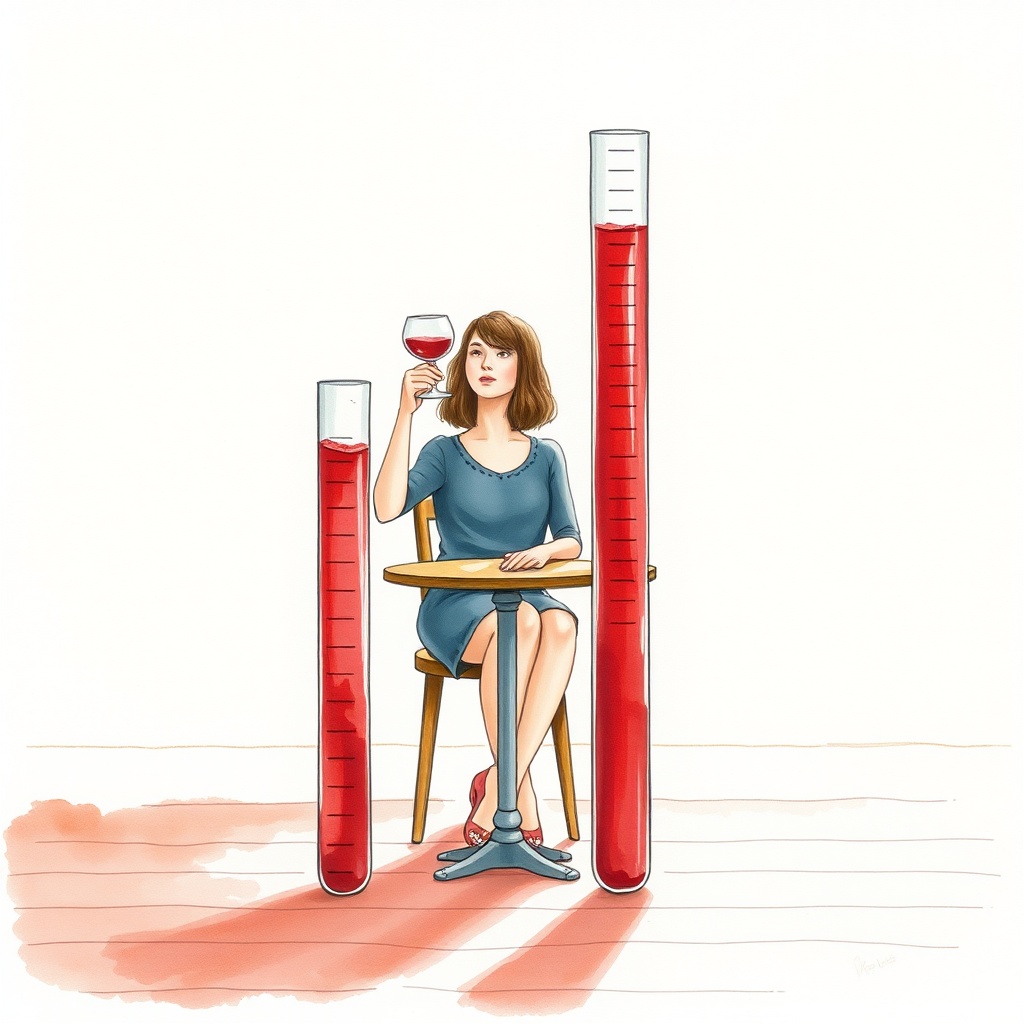

Take the same Swedish clinic patients and ask three ways whether they drink at a hazardous level. A blood test says roughly 15 to 18%. A questionnaire says 26.5%. Their own count of weekly drinks says 8.5%.
I build a drinking app, so "how much do you actually drink?" is more or less my job. I assumed doctors had a cleaner answer to it than I do. This paper from Annals of Family Medicine suggests they don't. They get three different answers depending on how they ask, and the authors say none of the three works well alone.
What they did
The team ran a retrospective cohort study. They pulled regional primary care health records in Sweden and linked them to national registries. Everyone in the analysis had taken a PEth (phosphatidylethanol) test, an alcohol biomarker measured in blood.
Then they built two samples:
- 3,679 patients who also had an AUDIT (Alcohol Use Disorders Identification Test, a standard screening questionnaire) score within 90 days before or after the blood test
- 8,934 patients whose weekly drinking was written down in the record within the same 90-day window
Each method got its own cutoff for hazardous use:
- PEth above 210 ng/mL (0.30 μmol/L)
- AUDIT score of 8 or higher
- 10 or more drinks per week
The researchers checked how the measures correlated. They also used proportional-odds models (a type of regression for ordered categories) and adjusted for sociodemographic and clinical characteristics. It's all records, so they only saw patients a clinician chose to test. My guess is that already skews the group toward people a doctor had some reason to ask about.
What they found
The share of patients flagged depended heavily on the method:
- AUDIT flagged the most, 26.5%
- PEth flagged 14.6% in the first sample and 18.3% in the second
- Self-reported weekly drinks flagged the fewest, 8.5%
Each method also caught patients the other two missed. So you can't line them up as "strict test" versus "lenient test." The groups only partly overlap.
PEth correlated moderately with both AUDIT scores and weekly drinks. The relationships were nonlinear, though. A higher blood level doesn't map onto a proportionally higher score or drink count.
The part I found most interesting is what happened at the SAME blood level:
- Men reported more weekly drinks than women with similar PEth.
- Patients with more education and higher income also reported more weekly drinks.
- Younger patients scored higher on AUDIT.
Two people with matching blood results can tell their doctor quite different stories about their drinking.
What it means
The authors conclude that the biomarker and the self-reports capture overlapping but distinct parts of how someone drinks. For clinicians the practical rule is simple: read PEth next to what the patient says, and don't treat it as a standalone verdict.
I keep coming back to the 8.5%. It's the lowest of the three, and I don't think that's an accident. A weekly drink count is something you reconstruct from memory, usually sitting in a doctor's office, and memory tends to be generous with us. I can't prove that from this paper, since it doesn't say which method is closest to the truth. But it fits a wider push among researchers to stop relying on what people remember drinking.
The demographic gaps are harder to read. Maybe men and higher-income patients are simply more candid. Maybe they count drinks differently, or maybe the blood marker itself varies between people. The study doesn't explain it, and I'd rather leave it open than guess. The age finding points the same way: the questionnaire seems to pick up something in younger patients that the blood number doesn't.
For my own thinking, self-perception is the shakiest instrument we have. That rhymes with an earlier finding that the most intoxicated people were the worst at judging how drunk they were. Looking back over a week blurs things. So does being in the middle of a night.
That's where I see AlcoBalance fitting, in a narrow way. A weekly total is a summary you piece together after the fact. During the evening itself, the app lets you notice your pace picking up and see where your peak is likely to land, while you can still choose to ease off. It isn't a screening tool, and it doesn't replace a PEth test. It just gives you a clearer view of the moment, so you depend less on a generous memory later.
The authors end on the idea that combining methods supports more individual conversations between patients and clinicians. I like that. Three numbers that disagree are a good reason to ask one more question.
Source: Annals of Family Medicine, DOI